
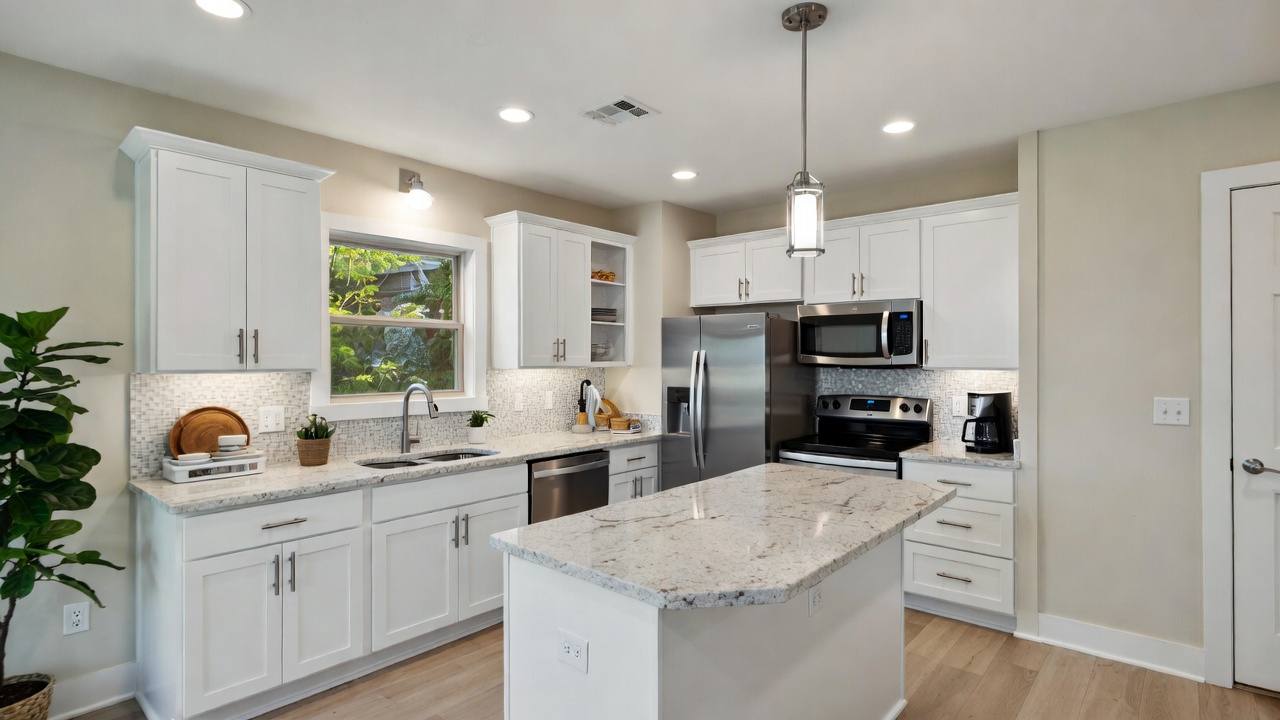
Kitchen Command Center Designing the Room Where Life Actually Happens
Kitchen Command Center Designing the Room: Let’s be real. In, the kitchen isn’t just where we cook. It’s the unofficial headquarters of everything. It’s where homework gets done on the island, where friends congregate with wine while you’re chopping veggies, where the big family decisions are made over a pot of coffee, and where you stand in silence at 11 PM eating cold leftovers straight from the container.
It’s the hardest-working room in the house. So, designing it isn’t about picking pretty backsplash tiles and calling it a day. It’s a strategic mission to create a space that can handle the beautiful, messy, chaotic, and joyful reality of daily life. This is about building your kitchen’s bones, spirit, and smile.
Before you fall in love with a photo of a farmhouse sink or a commercial-grade range, you have to do some serious thinking. Not about styles, but about your life Grab a notepad and ask some hard questions. Who’s the head chef? Is it one person who needs an efficient, restaurant-style line for serious cooking, or is it a family affair where multiple people need to move without bumping hips? This determines your layout and how much “landing space” you need next to appliances.
What’s your food personality? Are you a weekly meal-prepper who needs massive refrigerator space and a battalion of containers, a baker who dreams of a marble slab for rolling dough, or a “grab-and-go” family where the blender and toaster are the MVPs? Your habits dictate your appliance priorities and countertop real estate. How do you live in here? Is the kitchen a through-way to the backyard, the central hub for parties, or the primary spot for paying bills and sorting mail? Answering these questions honestly is like creating a blueprint for your happiness. It moves you away from what’s trendy and towards what’s truly functional for you.
Now, let’s talk about the most important, unsexy part of kitchen design: the triangle. The sink, the stove, and the refrigerator. This isn’t a dusty old rule; it’s the law of physics for a cook. Picture yourself making pasta. You take the pot from the sink, carry it to the stove, then get the salt from the fridge. If you have to trek across a vast continent of an island for each step, you’ll be exhausted before the water boils. The goal is to create a compact, flowing path between these three points. Kitchen Command Center Designing the Room Where Life Actually Happens
No major traffic jams, like the dishwasher door blocking the fridge, and no giant distances to travel. The classic layouts Galley, L-Shape, U-Shape, and Island are all solutions to this triangle puzzle. A galley kitchen creates a super-efficient corridor. An L-shape can tuck the triangle neatly into a corner. A single-wall kitchen demands ruthless minimalism. The key is to respect the dance of cooking. Stand in your space, real or imagined, and mime making your famous chili. Your body will tell you what feels right.
The heart of the kitchen’s function lies in its zones. Think of your kitchen not as one room, but as five dedicated stations. The Consumables Zone is where food lives: the refrigerator and pantry. It should be adjacent to the Non-Consumables Zone, where plates, glasses, and everyday bowls are stored, typically near the dishwasher for easy unloading. The Cleaning Zone is anchored by the sink and dishwasher, requiring a large stretch of counter for dirty dishes on one side and clean ones on the other.
The Preparation Zone is the sacred, flat countertop land between the sink and the cooktop, dedicated solely to chopping and mixing. Finally, the Cooking Zone houses the range, oven, and microwave, with overhead storage for pots, oils, and spices. Designing with these zones in mind is like giving everything in your kitchen a neighborhood. It cuts down on steps, reduces clutter, and turns chaos into calm efficiency. It’s the difference between a kitchen that fights you and one that works with you.Kitchen Command Center Designing the Room
With your flow and zones mapped, you can finally start to build the personality. This is where choices become emotional. Let’s start with the biggest surface: countertops. This is your kitchen’s workbench, and the material sets the tone. Quartz is the popular, practical champion incredibly durable, non-porous, and low-maintenance, coming in a wild variety of colors and patterns.
Granite offers natural, unique beauty, but requires annual sealing. Butcher block brings instant warmth and a soft surface for baking, but it needs oiling and can show cuts and stains. Marble is the classic beauty, cool and perfect for pastry, but it etches and stains easily, developing a patina that you must learn to love. The choice here is a metaphor: do you want perfection or personality? Ease or tradition? Your countertop is the foundation of your kitchen’s story.Kitchen Command Center Designing the Room
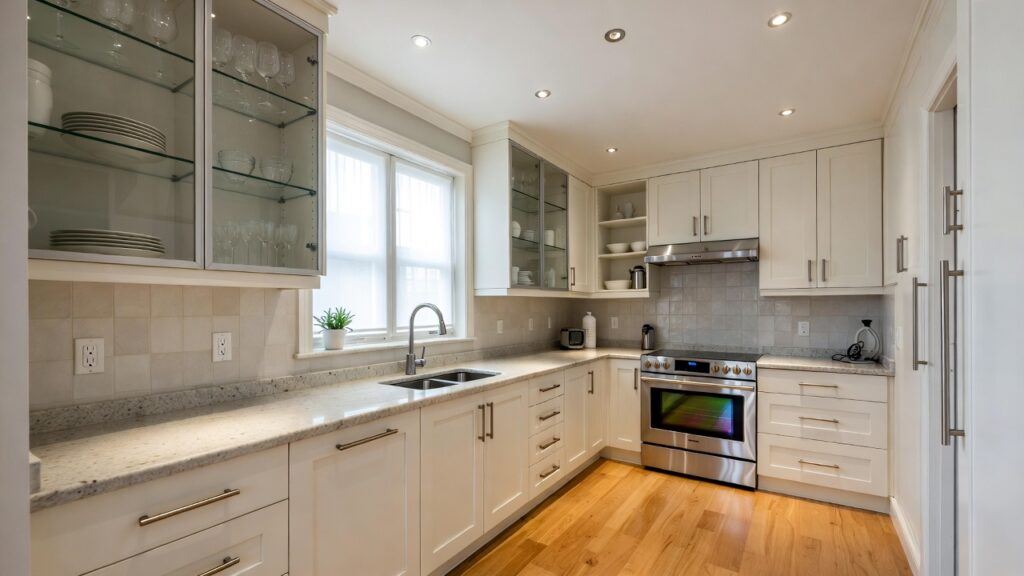
The cabinet conversation is about balance the balance of storage and style, and the balance of closed and open. Cabinets that go all the way to the ceiling look sleek but can become a black hole for the platter you use once a year. Smart storage is honest storage. Deep drawers for pots and pans are a game-changer over lower cabinets. Pull-out shelves in base cabinets save your back. A dedicated tray cabinet next to the oven is a small miracle.Kitchen Command Center Designing the Room
The trend of open shelving is beautiful but asks a hard question: are you willing to keep those dishes and glasses camera-ready at all times? For most of us, a mix is best. A few open shelves for beautiful, daily-use items near the sink or stove, and plenty of smart, closed cabinets to hide the mismatch of plastic containers and the appliance graveyard. Don’t forget the insides drawer dividers for utensils, tray dividers for cutting boards, and vertical slots for baking sheets can transform your daily experience.
The backsplash and flooring are your kitchen’s jewelry and shoes they need to be both stylish and tough. The backsplash is your chance to inject pattern, color, or shine without a huge commitment. A simple white subway tile laid in a vertical stack feels fresh. A handmade zellige tile adds shimmering, organic texture. A large-format slab of the same material as your countertop creates a seamless, modern waterfall effect. The key is to choose something you won’t tire of and that is easy to wipe down. For flooring, forget anything delicate. You need a soldier.
Porcelain tile that looks like wood or stone is incredibly durable and waterproof. Luxury Vinyl Plank (LVP) is a comfort-focused, resilient winner. If you love real wood, choose a harder species like oak with a matte finish to hide scratches. These surfaces take the brunt of spills, drops, and foot traffic, so choose for endurance first and beauty a very close second.Kitchen Command Center Designing the Room
Lighting is what separates a functional kitchen from a magical one. A single, glaring ceiling fixture is the enemy of atmosphere and creates shadows on your cutting board. You need a layered approach. Ambient lighting provides overall illumination, often from recessed cans or a central fixture on a dimmer. Task lighting is non-negotiable: under-cabinet lighting that brightly illuminates your countertop work zones is a safety and sanity essential.
Accent lighting adds the sparkle maybe a beautiful pendant over the island or a small lamp on a command station. The color temperature matters immensely. Look for bulbs in the “warm white” range (2700K-3000K). The sterile, blue-toned “daylight” bulbs (5000K+) make food look unappetizing and feel like a laboratory. Warm light makes complexions glow, makes wood tones richer, and makes the space feel welcoming. Dimmers are your best friend, allowing you to shift from bright morning prep to soft, evening cocktail mode.Kitchen Command Center Designing the Room
Finally, we come to the soul of the kitchen: the details that make it yours. This is the antidote to the sterile showroom. It’s the collection of ceramic bowls on the open shelf you found on a road trip. It’s the vintage advertising sign leaning against the backsplash. Kitchen Command Center Designing the Room
It’s the worn wooden spoon in the crock by the stove that just stirs better. It’s the dog bowl tucked neatly in a corner and the chalkboard wall with the week’s scrawled menu. Your kitchen should have laugh lines. It should have the small scorch mark on the counter from a pan that was too hot and the perfectly placed hook for your grandmother’s apron. The
design the triangle, the zones, the durable materials is just the stage. The life you live there is the show. Choose hardware that feels good in your hand. Display the art that makes you smile. Let the coffee maker make its permanent ring.Kitchen Command Center Designing the Room
Designing a kitchen is a profound act of self-knowledge. It requires you to envision your best, most organized, most joyful self and then build the environment that supports that person. It’s about creating a space that doesn’t just allow for life, but actively encourages it for nourishing your family, for welcoming your friends, for creating memories, and for finding a moment of peace with a cup of coffee as the sun comes up. Start with how you live. Build for how you move. Finish with what you love. The result won’t just be a kitchen. It will be your home’s true heart, beating strong and warm at the center of everything.